
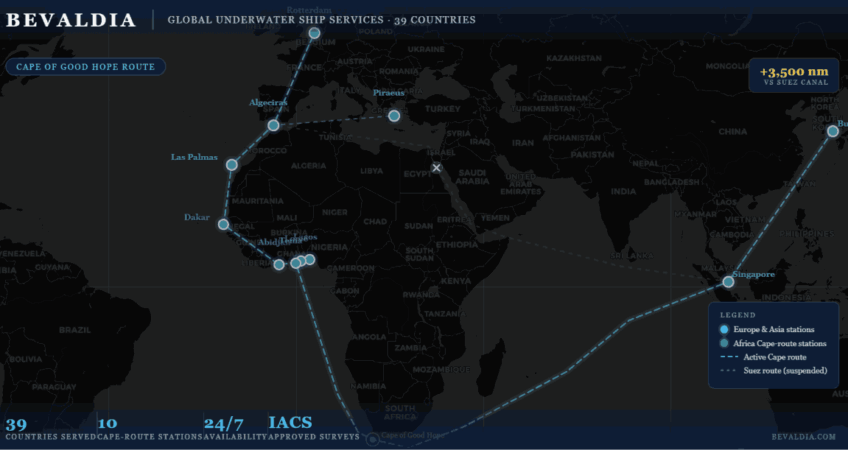
The closure of the Red Sea and the effective suspension of the Suez Canal have fundamentally changed how vessels move between Asia, Europe, and Africa. What was once a temporary detour has become the new standard: the Cape of Good Hope route is now the default for the vast majority of global container and tanker traffic, and industry analysts expect this to remain the case through at least 2027.
For ship owners, fleet managers, technical superintendents, charterers, and trade operators, this is not simply a navigation change. It is a maintenance challenge — one that requires a clear understanding of what the additional distance and time at sea means for the underwater condition of your vessel.
This advisory explains the practical implications of Cape routing for hull fouling, propeller performance, drydock scheduling, and CII compliance — and what steps vessel operators should be taking now.
 How Much Extra Distance and Time Are We Talking About?
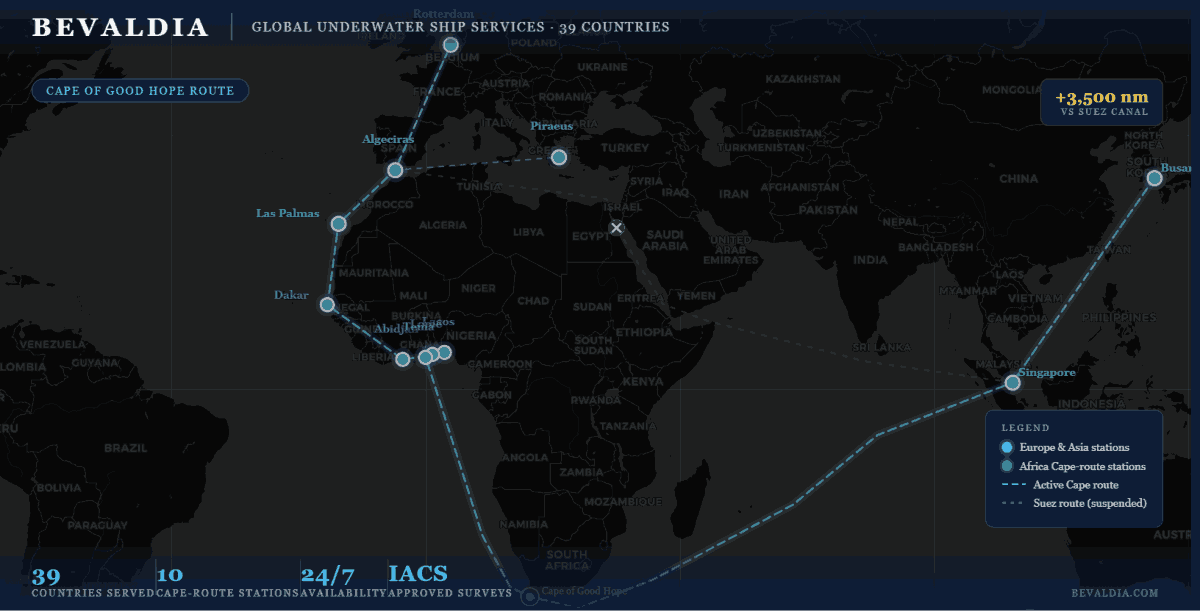
The Cape of Good Hope route between Asia and Northern Europe adds approximately 3,000 to 3,500 nautical miles to each voyage compared to the Suez Canal route. In terms of time, this translates to 10 to 14 extra days at sea per voyage, depending on vessel speed and routing.
For a vessel making six round voyages per year between Asia and Europe, this means:
- 36,000 to 42,000 additional nautical miles per year
- 60 to 84 additional days at sea per year
These are not small numbers. Every additional day at sea is a day during which the hull is accumulating biofouling and the propeller is experiencing wear. The maintenance intervals that were designed for Suez routing are, in most cases, no longer appropriate for Cape routing.
What Happens to the Hull on a Longer Voyage?
Biofouling Accumulates Faster Than Many Operators Expect
Biofouling is the accumulation of marine organisms — algae, barnacles, mussels, and other sea life — on the underwater hull of a vessel. All vessels experience biofouling. The rate at which it accumulates depends on several factors, including water temperature, vessel speed, the age of the antifouling paint coating, and — critically — time at sea.
The additional 10 to 14 days per Cape voyage means hulls are fouling faster than the antifouling paint was designed to handle on Suez-interval schedules. Many vessels are now arriving at their destination ports with significantly heavier fouling than their maintenance teams expected.
Why does this matter?
A heavily fouled hull creates drag. More drag means the vessel’s engine must work harder to maintain speed. More engine effort means higher fuel consumption. Studies consistently show that heavy hull fouling can increase fuel consumption by 10% to 40% depending on the severity.
For charterers and trade operators, this translates directly into higher voyage costs and potentially slower transit times — both of which affect commercial performance.
Antifouling Paint Coatings Are Reaching Their Limits Earlier
Most modern antifouling paint coatings are designed to provide protection for a set number of months or nautical miles between drydockings. Cape routing is accelerating the consumption of these coatings.
Operators who were previously managing hull condition comfortably within drydock intervals are now finding that their coatings are performing below specification earlier than expected. This makes in-water hull cleaning between drydockings not a luxury, but a practical necessity for vessels on regular Cape routing.
What Happens to the Propeller?
Propeller Performance Degrades Over Longer Voyages
The propeller is one of the most important contributors to a vessel’s fuel efficiency. A clean, smooth propeller surface transfers engine power into forward motion as efficiently as possible. Over time, and especially over longer voyages, the propeller surface becomes rougher due to:
- Marine growth — algae and other organisms attaching to the propeller blades
- Cavitation erosion — damage to the blade surface caused by the formation and collapse of bubbles at high speeds
- General surface roughness — gradual degradation of the polished surface finish
Each of these factors reduces propeller efficiency. On a standard Suez voyage, the degree of degradation was manageable within existing maintenance schedules. On Cape routing, with 10 to 14 additional days per voyage, the degradation is faster and the efficiency loss is greater.
Underwater propeller polishing — carried out by divers or remotely operated vehicles (ROVs) at port, without the vessel going to drydock — can restore the propeller surface to near-new condition and recover the lost fuel efficiency. For a vessel on regular Cape routing, scheduled propeller polishing at key wayport stops is now an important part of fuel cost management.
What Does This Mean for CII Compliance?
The Carbon Intensity Indicator (CII) Is Directly Affected by Cape Routing
The Carbon Intensity Indicator (CII) is the International Maritime Organization’s (IMO) framework for measuring and rating a vessel’s carbon efficiency. Every vessel above 5,000 gross tonnes is assigned an annual CII rating — from A (best) to E (worst). A poor CII rating has commercial and regulatory consequences, including restrictions on trading.
CII is calculated based on the amount of fuel a vessel consumes relative to the distance it travels and the cargo it carries. Cape routing creates a specific CII challenge:
- More fuel consumed — due to longer distances and heavier hull fouling
- More distance travelled — which partially offsets the fuel increase, but not completely
- Net effect — for many vessel types and trade routes, Cape routing is resulting in worse CII ratings than Suez routing produced
Fleet managers and technical superintendents are reporting that vessels which were comfortably rated B or C on Suez routing are now under pressure to maintain those ratings on Cape routing. Hull cleaning and propeller polishing — by reducing drag and recovering propeller efficiency — are among the most effective practical tools for managing CII ratings without reducing speed or cargo loads.
What Does This Mean for Drydock Scheduling?
Drydock Intervals Were Designed for a Different World
Standard drydock intervals of 5 years (with intermediate surveys) were established when the Suez Canal route was the norm. The additional nautical miles and sea days introduced by Cape routing mean that:
- Hull coatings are reaching their limits earlier
- Propeller wear is accumulating faster
- Underwater equipment — anodes, sea chests, rope cutters — is requiring attention sooner
This does not necessarily mean that vessels need to drydock more frequently. It does mean that in-water maintenance between drydockings needs to become a more structured and regular part of fleet management.
In-water services that were previously used on an occasional or emergency basis — hull cleaning, propeller polishing, anode replacement, sea chest cleaning — now need to be planned as routine maintenance items at key ports along the Cape route.
Drydock Extension Is Possible – With the Right In-Water Inspections
For operators who are approaching a scheduled drydocking but whose vessel is in good condition, it is possible to extend the drydock interval through in-water class surveys carried out by IACS-approved diving teams. These surveys are accepted by all major classification societies — DNV, ABS, Lloyd’s Register, Bureau Veritas, and others — and can provide the evidence needed to justify an interval extension.
This is a significant cost saving. A drydocking typically costs several hundred thousand dollars, plus the cost of off-hire time. An in-water survey costs a fraction of this and can delay the drydocking by a meaningful period if the underwater condition of the vessel supports it.
The Ports Where Maintenance Now Matters Most
Cape-route vessels typically call at a predictable set of wayports — ports along the route where they stop for bunkering, cargo operations, or crew changes. These are the ports where underwater maintenance is most practical and most valuable.
On the Cape route between Asia and Northern Europe, the key maintenance ports are:
Departing Asia:
- Singapore — the world’s busiest ship service hub, ideal for pre-departure hull cleaning and propeller polishing
- Busan, South Korea — a major hub for vessels on North Pacific and Asia-Europe trades
West Africa:
- Lomé, Togo — one of West Africa’s deepest natural harbours and a growing Cape-route stop
- Abidjan, Ivory Coast — the largest port in West Africa
- Lagos, Nigeria — the most active port market in West Africa
- Tema, Ghana and Dakar, Senegal — increasing in importance as Cape-route traffic grows
Atlantic waypoints:
- Las Palmas, Gran Canaria — a critical Atlantic crossing point, ideal for mid-voyage maintenance
- Algeciras, Spain — Europe’s busiest transshipment port, the first major European stop northbound
Northern Europe:
- Rotterdam, Netherlands — Europe’s largest port and the primary Northern European destination
BEVALDIA operates certified diving stations at all of these locations, with teams available 24/7 for both scheduled and emergency underwater services.
Practical Recommendations for Fleet Operators
Based on the implications outlined above, we recommend the following for vessels regularly operating on Cape routing:
- Review your hull cleaning intervals
If your current hull cleaning schedule was set for Suez-route intervals, it is likely no longer appropriate for Cape routing. Review the schedule with your technical superintendent and consider adding a planned in-water hull cleaning at a key wayport — Singapore or Las Palmas are natural choices depending on direction of travel. - Schedule propeller polishing at Cape wayports
Propeller polishing at Singapore before departure and at Algeciras or Rotterdam on arrival can deliver measurable fuel savings over the Cape voyage. Given the length of the voyage, even a 1–2% improvement in propeller efficiency represents a significant fuel cost saving. - Monitor your CII rating actively
If your vessel’s CII rating has deteriorated since Cape routing became the norm, hull and propeller maintenance should be part of your remediation plan alongside speed and cargo optimisation. - Consider in-water surveys before your next drydocking
If your vessel is approaching a scheduled drydocking, an in-water class survey at a Cape wayport can assess whether the interval can be extended. Contact your classification society and an IACS-approved diving company to understand your options. - Brief your chartering and operations teams
Charterers and trade operators need to understand that Cape routing has maintenance implications that affect vessel performance and fuel costs. Building planned maintenance stops into voyage schedules — rather than treating underwater services as an emergency measure — is the more efficient and cost-effective approach.
How BEVALDIA Can Help
BEVALDIA is a global underwater ship services company operating in 39 countries. Our certified diving teams provide hull cleaning, propeller polishing, in-water class surveys, CCTV inspections, anode replacement, and a full range of underwater repair services at ports across the Cape route — including Singapore, Busan, Lomé, Abidjan, Lagos, Las Palmas, Algeciras, and Rotterdam.
All BEVALDIA services are carried out by experienced, certified teams in compliance with ISO 9001:2015, 14001:2015 and 45001:2018. Our in-water surveys are IACS approved and accepted by all major classification societies.
We respond to all service requests 24/7. To discuss your vessel’s maintenance requirements on the Cape route, contact our team at [email protected] or call (+30) 210 400 1120.
BEVALDIA — Global Underwater Ship Services in 39 Countries
ISO 9001:2015 | ISO 14001:2015 | ISO 45001:2018 | IACS Approved